From Tightness to Pain: Solving IT Band–Related Hip Issues
If you’re struggling with pain on the outside of your hip or thigh, you may be dealing with IT Band–related hip issues. While many people assume the problem is simply a “tight IT band,” research shows the real cause is often more complex. True recovery requires addressing pelvic positioning, glute strength, foot mechanics, and core stability — not just stretching.
At Custom Chiropractor, we frequently help patients resolve IT Band–related hip issues by correcting the underlying imbalances that create chronic tension and inflammation.
What Is IT Band Syndrome?
The iliotibial (IT) band is a thick band of connective tissue that runs from the outside of your hip to the outside of your knee. It is formed from the fascia of the glute muscles and the tensor fascia latae (TFL). When irritation develops at the lateral hip or knee due to repetitive friction or poor mechanics, it is referred to as IT Band Syndrome.
IT Band–related hip issues can present as pain at the lateral hip, snapping over the greater trochanter (“snapping hip”), or tenderness that worsens with activity. Early on, symptoms may disappear after warming up. As the condition progresses, discomfort can become more constant and may extend along the entire outer thigh.
Why IT Band–Related Hip Issues Develop
Research shows that IT Band–related hip issues are rarely caused by the IT band itself being “short.” Instead, they result from:
- Poor pelvic positioning (anterior pelvic tilt)
- Gluteus medius weakness
- Overactive tensor fascia latae (TFL)
- Adductor imbalance
- Foot over-pronation or poor arch control
- Rapid increases in mileage or downhill training
Runners are particularly prone to IT Band–related hip issues due to repetitive loading and endurance demands. However, we also see this condition in active adults, postpartum patients, and individuals who sit for prolonged periods.
The Pelvis: The Missing Link in IT Band–Related Hip Issues
One of the most overlooked contributors to IT Band–related hip issues is anterior pelvic tilt (APT). When the pelvis tips forward:
- The TFL becomes more dominant.
- The glute medius and glute max become less efficient.
- The piriformis compensates excessively.
This imbalance increases lateral hip tension and drives more load into the IT band.
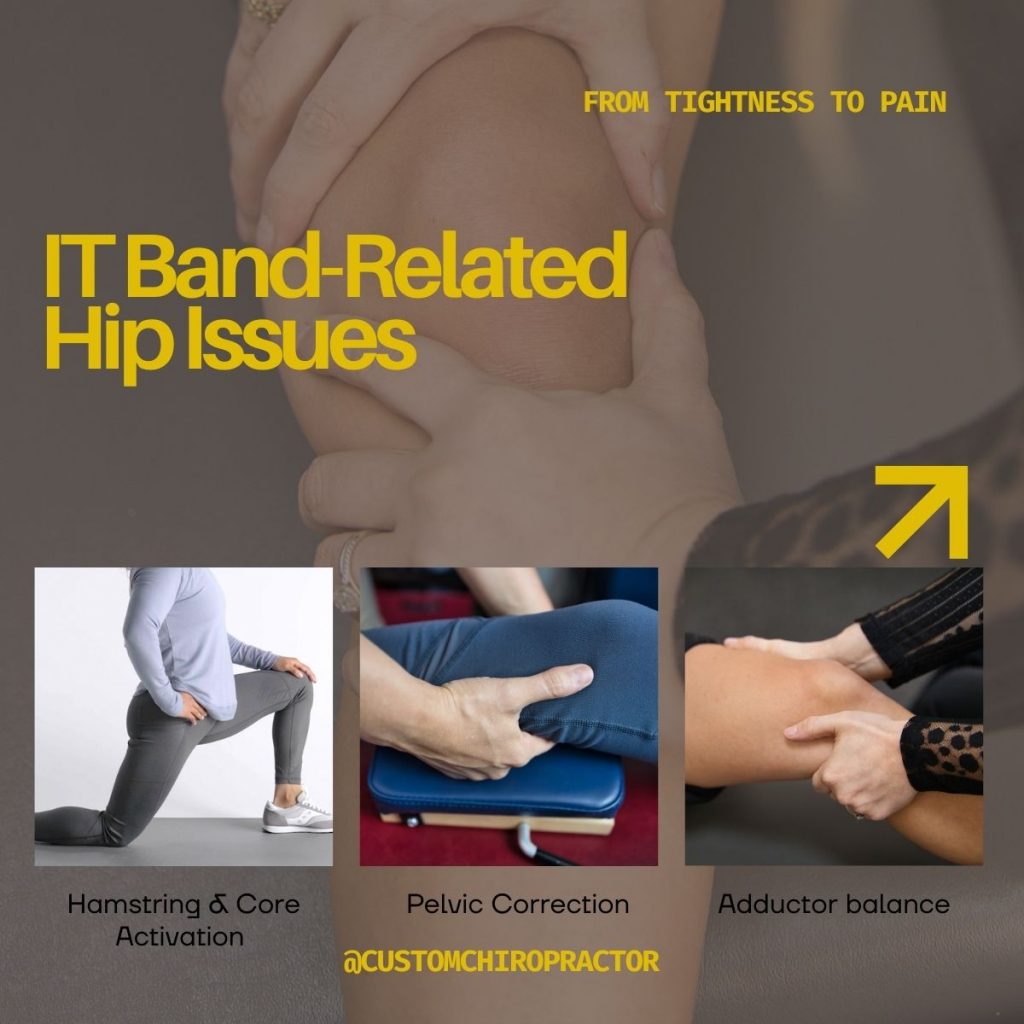
Research shows that activating the proximal hamstrings and lower abdominals can reduce anterior pelvic tilt, decrease tension in the lateral hip musculature, and immediately reduce pain. This is why treatment at Custom Chiropractor focuses on restoring pelvic alignment before progressing into strengthening.
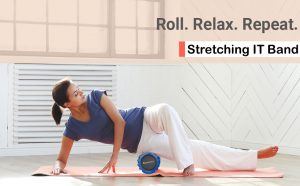
Why Stretching and Foam Rolling Aren’t Enough
Many patients attempt to fix IT Band–related hip issues by aggressively stretching or foam rolling the IT band. However:
- The IT band itself does not significantly change length.
- Foam rolling may temporarily reduce tension (often lasting only minutes).
- Stretching does not correct pelvic or muscle imbalances.
Instead of asking, “How can I stretch my IT band?” the better question is, “How can I reduce the tension being placed on it?”
This requires addressing muscle function — especially the glute medius.
Gluteus Medius: The Key to Solving IT Band–Related Hip Issues
Research consistently shows that individuals with IT Band–related hip issues demonstrate gluteus medius weakness. In fact, one study found that runners who completed a six-week glute med strengthening protocol had a 90% pain-free return to running.
The glute medius has three portions:
- Posterior fibers (external rotation)
- Middle fibers (abduction)
- Anterior fibers (internal rotation and pelvic control)
Traditional exercises like clamshells do not always target the anterior fibers — which are often the weakest. Exercises such as hip hikes, femoral internal rotation drills, and controlled single-leg squats are far more effective for resolving IT Band–related hip issues.
We incorporate these strategies into rehabilitation plans outlined in our article on combining massage and chiropractic care.
Single-Leg Stability and Dynamic Control
If you cannot maintain pelvic level control during a single-leg squat, your body will compensate — often by collapsing into hip adduction and internal rotation. This movement pattern significantly increases strain contributing to IT Band–related hip issues.
Before returning to running, it is essential to assess:
- Hip stability in the frontal plane
- Knee tracking alignment
- Foot contact (heel, big toe, pinky toe)
- Endurance of glute medius activation
Strength without endurance is not enough. Many patients feel fine for a few repetitions but lose control over time, recreating stress that perpetuates IT Band–related hip issues.
The Role of Adductors in Hip Balance
Adductors are commonly misunderstood. When functioning properly, they help support eccentric glute lengthening and improve femoral positioning in the hip socket.
Adding isometric adduction (such as squeezing a block during bridges or squats) can enhance glute max activation and improve pelvic positioning. Balanced adductor engagement reduces excessive TFL dominance — a common driver of IT Band–related hip issues.
Core Stability and Rib Cage Positioning
Your core is the “glue” that stabilizes the pelvis and spine. Research demonstrates that purposeful core engagement increases glute max activation during hip exercises.
If your pelvis rotates or tips during movement, lateral hip tissues compensate. Deadbugs, side planks, and controlled breathing drills improve transverse abdominal activation and reduce stress contributing to IT Band–related hip issues.
Explore more movement optimization strategies in our chiropractic wellness resources.
Foot Mechanics and Tibial Rotation
If progress stalls, it may be time to look below the hip. Over-pronation, limited tibial internal rotation, or arch collapse can alter knee and hip mechanics.
When the tibia cannot internally rotate effectively, shock absorption decreases and tension increases through the lateral chain. Addressing foot pronation and supination mechanics helps reduce forces contributing to IT Band–related hip issues.
Comprehensive Treatment for IT Band–Related Hip Issues
True resolution of IT Band–related hip issues requires:
- Pelvic alignment correction
- Hamstring and lower abdominal activation
- Targeted glute med strengthening (anterior fibers included)
- Adductor balance
- Core stability training
- Foot and tibial mobility assessment
- Temporary activity modification
At Custom Chiropractor, we combine chiropractic adjustments, corrective exercise, and massage therapy to address every contributing factor — not just the symptoms.
Final Thoughts: From Tightness to Strength
IT Band–related hip issues are not simply a “tight band” problem. They are a movement system issue involving the pelvis, glutes, core, and feet. By correcting imbalances and building endurance in key stabilizers, you can move from chronic tightness to lasting relief.
If you’re experiencing persistent lateral hip pain, schedule an evaluation at Custom Chiropractor and let our team create a personalized plan to eliminate your IT Band–related hip issues at the source.