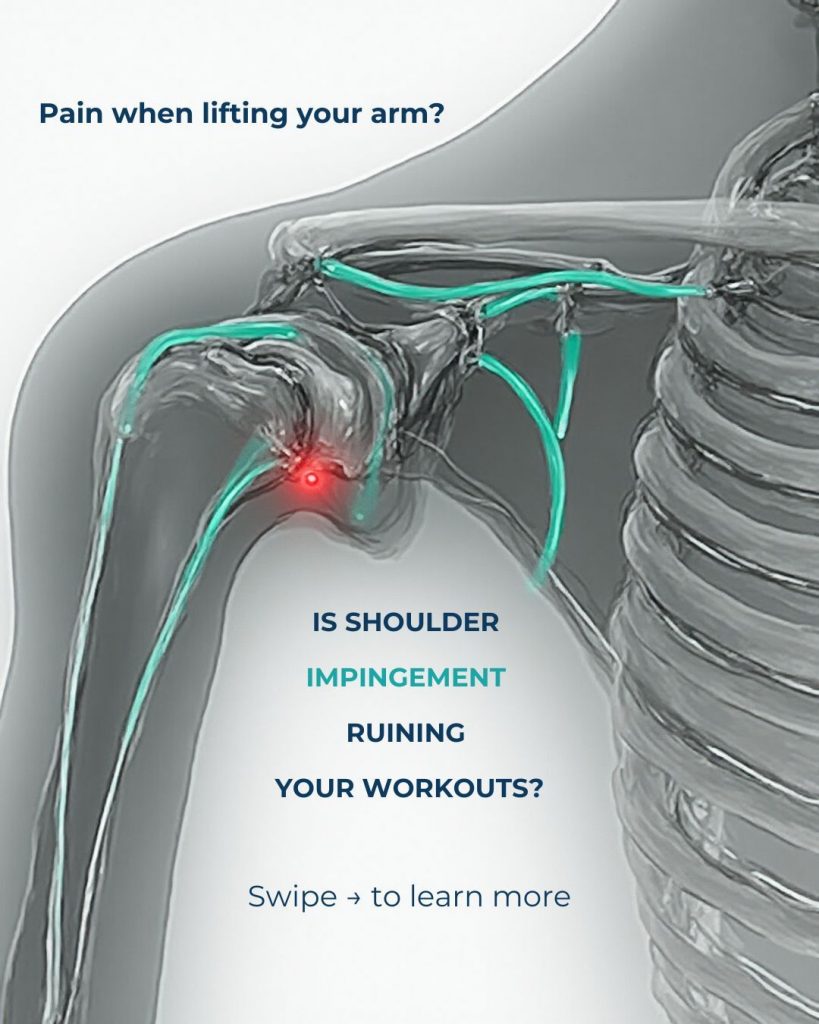
Shoulder impingement is one of the most common causes of shoulder pain among athletes, fitness enthusiasts, and people who perform repetitive overhead activities. If you feel a sharp pinch, ache, or weakness when lifting your arm overhead, performing push-ups, or pressing weights, shoulder impingement could be the culprit.
The good news is that shoulder impingement does not necessarily mean you have to stop working out. With the right knowledge, treatment, and movement strategies, many people can continue exercising safely while addressing the root cause of their pain.
In this article, we’ll break down what shoulder impingement is, why it happens, and how you can manage it without giving up the activities you love.
What Is the Shoulder?
The shoulder is one of the most mobile joints in the human body. It allows us to lift, rotate, push, pull, and reach overhead. However, that incredible mobility comes with a tradeoff: less inherent stability compared to other joints.
The shoulder complex includes several structures working together:
- The glenohumeral joint (ball-and-socket joint)
- The acromion (part of the shoulder blade)
- The rotator cuff muscles
- The bursa (a small fluid-filled sac that reduces friction)
- The scapula (shoulder blade)
For smooth movement, these structures must coordinate properly. When something interferes with that movement, shoulder impingement can occur.
If you want to learn more about how spinal and joint mechanics affect shoulder health, visit Custom Chiropractic for additional educational resources.
What Is Shoulder Impingement?
Shoulder impingement occurs when the tendons of the rotator cuff or the bursa become compressed between the humerus (upper arm bone) and the acromion during shoulder movement.
This compression often occurs during overhead movements such as:
- Weightlifting
- Swimming
- Throwing sports
- Tennis
- CrossFit training
When the tissues repeatedly get pinched, inflammation, irritation, and pain can develop.
If you’re experiencing persistent shoulder pain, our article on shoulder pain treatment options provides additional guidance.
Anatomical vs Functional Shoulder Impingement
Not all cases of shoulder impingement are the same. Clinically, it is often divided into two broad categories.
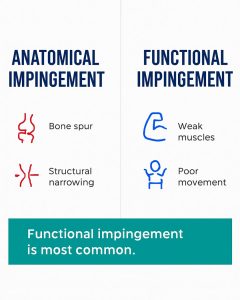
Anatomical (Structural) Impingement
Anatomical impingement occurs when structural features physically reduce the space in the shoulder joint. Examples include:
- Bone spurs
- Acromion shape variations
- Arthritic changes
- Thickened ligament
- Over time, untreated shoulder impingement can lead to reduced strength, limited range of motion, and difficulty performing everyday activities.
These structural factors may narrow the subacromial space,
- Weak rotator cuff muscles
- Poor scapular control
- Thoracic spine stiffness
- Muscle imbalances
- Improper training technique making shoulder impingement more likely during movement.
Functional Impingement
Functional impingement is far more common and occurs when poor movement patterns or muscle imbalances cause the shoulder to move inefficiently.
Contributing factors can include:
In many cases, functional shoulder impingement can improve significantly with proper rehabilitation and movement retraining.
The Overhead and Overuse Dilemma
Overhead activities place significant demand on the shoulder joint. Studies show that athletes and workers who perform repetitive overhead tasks have 2–3 times higher rates of shoulder problems compared to those who do not.
This includes populations such as:
- Baseball and volleyball players
- Swimmers
- CrossFit athletes
- Painters
- Electricians
- Construction workers
Because overhead movements are essential in many sports and occupations, completely avoiding them is rarely a practical solution. Unfortunately, many people are told to simply stop the activities that cause discomfort.
This can lead to what is known as activity avoidance, where individuals progressively eliminate exercises and movements due to fear of pain.
But eliminating movement entirely rarely solves the underlying issue of shoulder impingement.
Why End-Range Movements Are More Vulnerable
Here is an important concept that applies to every joint in the body.
End-range movements are typically weaker and more vulnerable than mid-range movements without proper conditioning.
When the shoulder is fully elevated overhead, several structures are placed under greater mechanical stress. If the muscles responsible for stabilizing the joint are not properly conditioned, the risk of shoulder impingement increases.
This is why progressive strengthening and proper load management are critical components of treatment.
Our clinic often incorporates mobility and stability strategies similar to those discussed in our guide to managing musculoskeletal pain.
Common Contributing Factors to Shoulder Impingement
Shoulder impingement rarely occurs because of a single cause. Instead, it typically develops due to a combination of physical, psychological, and lifestyle factors.
Understanding these contributing factors can help guide a more effective treatment plan.
1. Load Management Errors
One of the most common causes of shoulder impingement is sudden changes in training volume or intensity. Examples include:
- Increasing weight too quickly
- Adding too many overhead exercises
- Returning to sport too aggressively after time off
2. Poor Conditioning
Weak or poorly conditioned muscles cannot adequately stabilize the shoulder joint, increasing the risk of tissue irritation and shoulder impingement.
3. Kinesiophobia (Fear of Movement)
When pain develops, many people become fearful of moving their shoulder. This fear, known as kinesiophobia, can actually worsen outcomes by reducing strength and mobility.
4. Low Self-Efficacy
If individuals believe they cannot improve or recover, they may be less likely to engage in rehabilitation programs that help resolve shoulder impingement.
5. Sleep Disturbance
Sleep plays a major role in tissue recovery and pain perception. Poor sleep can increase pain sensitivity and prolong recovery from shoulder impingement.
6. Central Sensitization
In some cases, the nervous system becomes more sensitive to pain signals, amplifying discomfort even when tissue damage is minimal.
7. Social and Environmental Influences
Work demands, training culture, and peer expectations can influence how people respond to shoulder pain and whether they seek appropriate care.
Can You Still Work Out With Shoulder Impingement?
In many cases, yes. Most individuals with shoulder impingement can continue exercising with appropriate modifications.
Helpful strategies may include:
- Reducing painful overhead movements temporarily
- Improving shoulder and thoracic mobility
- Strengthening the rotator cuff and scapular muscles
- Adjusting training volume
- Improving exercise technique
The goal is not complete rest but rather progressive and controlled loading that allows the shoulder to adapt.
When to Seek Professional Help
If your symptoms persist for several weeks, worsen with activity, or significantly limit your ability to exercise, it may be beneficial to consult a healthcare professional.
A thorough evaluation can determine whether your symptoms are truly related to shoulder impingement and help identify the underlying contributing factors.
At Custom Chiropractic, we focus on movement-based care, rehabilitation, and personalized treatment strategies designed to restore function and reduce pain.
Final Thoughts
Shoulder impingement can be frustrating, especially for individuals who enjoy staying active. However, it does not necessarily mean the end of your workouts.
By understanding the mechanics of the shoulder, addressing contributing factors, and implementing a smart training strategy, many people successfully return to pain-free exercise.
If shoulder pain is limiting your workouts or daily activities, learning more about shoulder impingement and seeking appropriate care can be the first step toward recovery and long-term shoulder health.