Wrist Flexor Stretch: How to Do It Safely and Relieve Forearm Tension
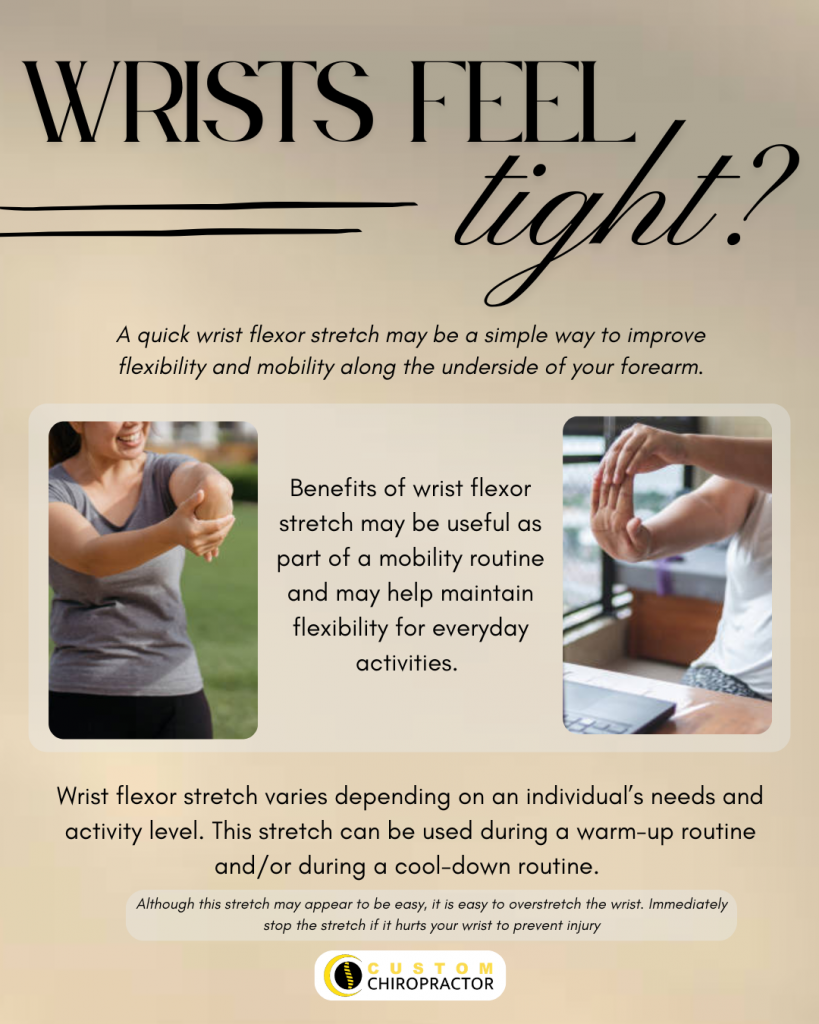
If your wrists feel tight after typing, lifting weights, playing sports, or performing repetitive tasks, a Wrist Flexor Stretch may be a simple way to improve flexibility and mobility. The wrist flexors are a group of muscles that run along the underside of your forearm and help you bend your wrist and fingers. When these muscles become overworked or tight, you may notice stiffness, discomfort, or reduced range of motion.
Fortunately, a gentle Wrist Flexor Stretch requires no equipment and can be performed almost anywhere. However, stretching is not appropriate for every type of wrist problem. Therefore, it is important to understand proper technique, when to stretch, and when wrist pain may require professional evaluation.
Custom Chiropractor treats a variety of musculoskeletal conditions, including shoulder, arm, wrist, and hand pain, while incorporating individualized exercises and soft-tissue therapies when appropriate.
What Is a Wrist Flexor Stretch?
A Wrist Flexor Stretch gently lengthens the muscles and connective tissues along the palm-side of the forearm. These muscles are involved in wrist flexion, gripping, typing, writing, and many other everyday movements.
Because the wrist and forearm work together, maintaining mobility in this area can be especially useful for people who perform repetitive hand activities. For example, prolonged computer use, gripping tools, weight training, musical instruments, and certain sports can place repeated demands on the wrist and forearm.
The American Academy of Orthopaedic Surgeons includes wrist flexion and extension stretches in its therapeutic exercise program for carpal tunnel syndrome. Its instructions emphasize gentle movement and caution that a stretch should be discontinued if it makes numbness uncomfortable. AAOS therapeutic exercise guidance provides additional information.
How to Perform a Wrist Flexor Stretch
Performing a Wrist Flexor Stretch correctly is more important than stretching aggressively. The goal is to create a mild, controlled stretch rather than pain.
- Sit or stand comfortably with your shoulders relaxed.
- Extend one arm in front of you with your elbow comfortably straight, but avoid forcefully locking it.
- Position your hand so your palm faces upward.
- With your opposite hand, gently hold the fingers of the extended hand.
- Slowly draw the fingers backward until you feel a gentle stretch along the underside of your forearm.
- Hold the position for approximately 15 to 30 seconds.
- Relax slowly and repeat on the opposite side.
You should feel tension through the forearm, not sharp pain inside the wrist. If the movement causes increased numbness, tingling, burning, weakness, or significant pain, stop the exercise and seek appropriate professional guidance.
What Are the Benefits of a Wrist Flexor Stretch?
A consistent Wrist Flexor Stretch can be useful as part of a broader mobility routine. Gentle stretching may help maintain flexibility and make everyday wrist movements more comfortable, particularly when stiffness is associated with repetitive activity.
Furthermore, stretching can complement other strategies such as strengthening, ergonomic improvements, activity modification, and individualized rehabilitation. Custom Chiropractor’s guide to stretching discusses the role stretching can play in maintaining muscle flexibility and preparing the body for activity.
However, stretching should not be viewed as a universal treatment for wrist pain. Wrist symptoms can have many different causes, including sprains, tendon problems, arthritis, nerve irritation, and carpal tunnel syndrome. The appropriate exercise depends on the underlying problem.
Wrist Flexor Stretch for People Who Type
People who spend hours at a keyboard or mouse may benefit from paying particular attention to wrist position throughout the day. Keeping the wrists in a neutral, comfortable position and taking regular movement breaks can reduce the amount of time the tissues remain under repetitive stress.
Custom Chiropractor’s ergonomics resources recommend keeping the arms relaxed and wrists straight while working, along with taking breaks and changing positions regularly. Its more recent article, Ergonomics That Actually Work, also discusses workstation positioning, movement breaks, and wrist and hand strain.
Consequently, adding a Wrist Flexor Stretch to your routine may make more sense when combined with better workstation habits rather than relying on stretching alone.
Wrist Flexor Stretch Before or After Exercise?
The best time to perform a Wrist Flexor Stretch depends on your activity and individual needs. Gentle mobility movements can be useful as part of a warm-up, particularly before activities involving gripping. After activity, gentle stretching can also be incorporated into a cool-down routine.
According to the AAOS therapeutic exercise program, wrist flexion and extension stretches may be performed throughout the day and can be incorporated into warm-ups after recovery. The recommended program should nevertheless be individualized, especially for someone with an existing wrist condition.
For athletes, workers, or anyone recovering from an injury, stretching should be only one component of a comprehensive plan. Depending on the situation, strengthening and rehabilitation exercises may be equally important. Custom Chiropractor explains the distinction between stretching tight muscles and strengthening weak muscles in its article Strengthen or Stretch?.
Common Mistakes When Doing a Wrist Flexor Stretch
Although a Wrist Flexor Stretch looks simple, several common mistakes can make it less effective or potentially aggravate symptoms.
- Stretching too aggressively: A stronger stretch is not necessarily a better stretch.
- Bouncing: Use slow, controlled movement rather than forcing the wrist repeatedly.
- Ignoring pain: Mild tension may be expected, but sharp or worsening pain is a reason to stop.
- Holding your breath: Breathe normally and keep your shoulders relaxed.
- Stretching without addressing the cause: If repetitive activity is creating the problem, changing the activity or workstation may be necessary.
Additionally, avoid assuming that every wrist symptom is caused by tight muscles. A persistent or recurring problem deserves a proper assessment.
When Should You Avoid a Wrist Flexor Stretch?
A Wrist Flexor Stretch may not be appropriate immediately following an acute injury or when the cause of pain is unknown. For example, significant swelling, bruising, deformity, severe pain, or difficulty moving the wrist can indicate a more serious injury.
The NHS notes that wrist pain can have many causes and recommends medical evaluation when symptoms interfere with normal activities, worsen or repeatedly return, persist despite home treatment, or involve tingling or loss of sensation. Severe pain, an inability to move the wrist or hold objects, changes in wrist shape or color, or loss of feeling require prompt attention. See the NHS wrist pain guidance for additional information.
When Wrist Pain May Need Professional Care
If wrist discomfort continues despite modifying activities and using gentle mobility exercises, professional evaluation can help determine what is actually causing the symptoms. This is especially important when pain occurs alongside numbness, tingling, weakness, reduced grip strength, or symptoms extending into the hand, arm, or neck.
For example, carpal tunnel syndrome involves compression of the median nerve at the wrist and can cause pain, numbness, and tingling. Custom Chiropractor’s article about carpal tunnel syndrome discusses wrist and nerve symptoms in greater detail.
Custom Chiropractor takes a broader approach to musculoskeletal complaints, evaluating how joints, muscles, posture, and movement interact. Its new patient information explains how individualized assessments and rehabilitative exercises may be incorporated into care.
How Often Should You Do a Wrist Flexor Stretch?
There is no single routine that works for everyone. If you are healthy and simply want to maintain mobility, a gentle Wrist Flexor Stretch can be incorporated into regular movement breaks. If you are recovering from an injury or managing a diagnosed condition, follow the exercise frequency recommended by your healthcare professional.
Most importantly, consistency and control matter more than forcing a deep stretch. Combine gentle wrist mobility with appropriate strengthening, ergonomic adjustments, and breaks from repetitive activities for a more complete approach to wrist health.
Final Thoughts on the Wrist Flexor Stretch
A Wrist Flexor Stretch is a simple mobility exercise that can help address forearm tightness and maintain comfortable wrist movement. When performed slowly and gently, it can be a useful addition to a warm-up, cool-down, or workplace movement routine.
Nevertheless, a Wrist Flexor Stretch is not a substitute for identifying the underlying cause of persistent wrist pain. If symptoms are severe, recurring, associated with numbness or weakness, or interfering with daily activities, consider getting your wrist evaluated.
If you are experiencing ongoing wrist, hand, arm, or shoulder discomfort, contact Custom Chiropractor to learn more about evaluation and personalized care in Santa Clara. You can also explore the clinic’s conditions treated for additional information about musculoskeletal problems and available treatment approaches.
Disclaimer: This article is for educational purposes only and does not replace individualized medical advice, diagnosis, or treatment. Stop any exercise that causes significant or worsening symptoms and seek professional evaluation when appropriate.