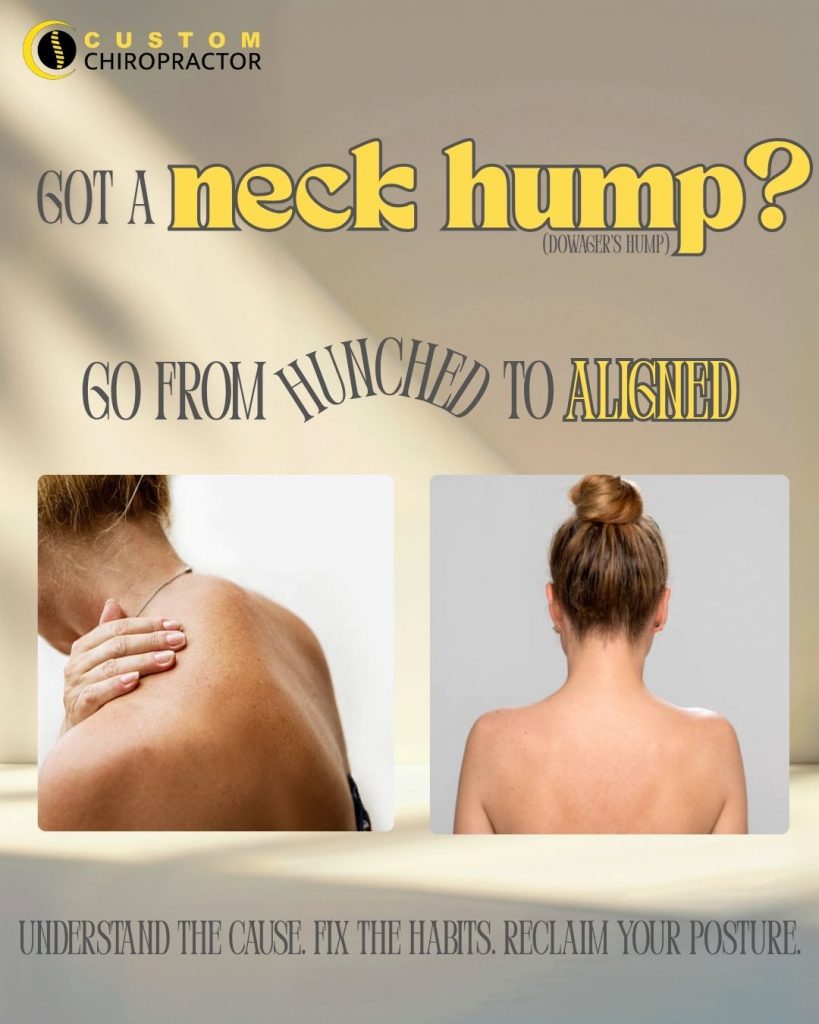
Neck Hump or Dowager’s Hump is a common postural condition that affects many people in today’s digital age. Often referred to as cervical kyphosis, this visible hump at the base of the neck is not just a cosmetic concern—it can reflect deeper structural, muscular, and lifestyle-related issues. In this article, we will break down exactly what the Neck Hump or Dowager’s Hump is, why it forms, and what you can do to prevent or improve it.
What Is Neck Hump or Dowager’s Hump?
The term Neck Hump or Dowager’s Hump refers to an excessive outward curvature of the upper spine, usually located around the C7 vertebra at the base of the neck. This condition can appear as a visible bump or rounding at the upper back. Medically, it is often associated with cervical kyphosis.
At Custom Chiropractor’s Dowager’s Hump page, this condition is explained as a combination of posture imbalance, muscular weakness, and tissue adaptation over time.
Main Causes of Neck Hump or Dowager’s Hump
There are several reasons why a Neck Hump or Dowager’s Hump develops. Most cases are multifactorial, meaning more than one cause is involved.
1. Poor Posture (Most Common Cause)
The leading cause of Neck Hump or Dowager’s Hump is poor posture, especially in the modern digital lifestyle. Prolonged sitting with the head tilted forward while using phones, laptops, or tablets creates a forward head posture.
For every centimeter the head moves forward, the load on the neck muscles increases dramatically. Over time, this stress causes the body to adapt. One adaptation is the development of a visible Neck Hump or Dowager’s Hump as the body attempts to stabilize the spine.
Learn more about posture correction at Posture Correction Resources.
2. Fat and Adipose Tissue Accumulation
Another cause of Neck Hump or Dowager’s Hump is the accumulation of adipose tissue or fat deposits. In some cases, the hump may be a lipoma or localized fat storage.
Conditions such as obesity or hormonal imbalance, including high cortisol levels (as seen in Cushing’s syndrome), can contribute to a “buffalo hump” appearance, which resembles a Neck Hump or Dowager’s Hump.
3. Osteoporosis and Age-Related Changes
In older adults, osteoporosis can weaken the vertebrae. This leads to compression of the spinal bones, causing the upper spine to curve forward. As a result, a Neck Hump or Dowager’s Hump becomes more visible.
This structural change is often progressive and requires medical and therapeutic attention.
4. Muscle Weakness and Imbalance
Weakness in the neck extensors and upper back muscles can also contribute to a Neck Hump or Dowager’s Hump. When these muscles cannot properly support the spine, the head gradually shifts forward and the upper back rounds.
Over time, the C7 vertebra becomes more prominent, increasing the appearance of a hump.
Symptoms Associated with Neck Hump or Dowager’s Hump
People with a Neck Hump or Dowager’s Hump may also experience:
- Neck stiffness and tightness
- Upper back pain
- Headaches
- Reduced neck mobility
- Rounded shoulders
These symptoms often worsen with prolonged sitting or poor workstation ergonomics.
Can Neck Hump or Dowager’s Hump Be Reversed?
The good news is that many cases of Neck Hump or Dowager’s Hump—especially those caused by posture and muscle imbalance—can be significantly improved or even corrected.
At Custom Chiropractor Blog, multiple approaches are discussed for restoring spinal alignment and improving posture.
How to Treat and Prevent Neck Hump or Dowager’s Hump
1. Targeted Exercises
Strengthening the neck extensors and upper back muscles is essential in correcting a Neck Hump or Dowager’s Hump. Exercises such as:
- Scapular retractions
- Chin tucks
- Upper back extensions
These help retrain posture and reduce forward head positioning.
2. Ergonomic Adjustments
One of the simplest ways to reduce a Neck Hump or Dowager’s Hump is improving your workstation setup. Keep screens at eye level and avoid prolonged downward head posture.
Explore ergonomic recommendations at Ergonomic Setup Guide.
3. Chiropractic and Manual Therapy
Chiropractic care and massage therapy can play an important role in treating a Neck Hump or Dowager’s Hump. These treatments help:
- Reduce muscle tension
- Improve joint mobility
- Restore spinal alignment
More information can be found at Chiropractic Care Services.
4. Lifestyle Changes
Reducing screen time, improving posture awareness, and incorporating movement breaks throughout the day can significantly reduce progression of a Neck Hump or Dowager’s Hump.
Why Early Intervention Matters
The earlier a Neck Hump or Dowager’s Hump is addressed, the better the outcomes. Early-stage postural changes are much easier to correct compared to long-standing structural changes or age-related spinal degeneration.
Ignoring a Neck Hump or Dowager’s Hump can lead to chronic pain, reduced mobility, and further spinal imbalance over time.
Final Thoughts
The Neck Hump or Dowager’s Hump is a common but often misunderstood condition. While it can be caused by multiple factors such as posture, fat accumulation, osteoporosis, or muscle weakness, the most common driver remains modern lifestyle habits.
The encouraging part is that in many cases, the Neck Hump or Dowager’s Hump is reversible with consistent effort, proper exercise, ergonomic correction, and manual therapy.
If you are noticing signs of a Neck Hump or Dowager’s Hump, taking action early can make a significant difference in your long-term spinal health.