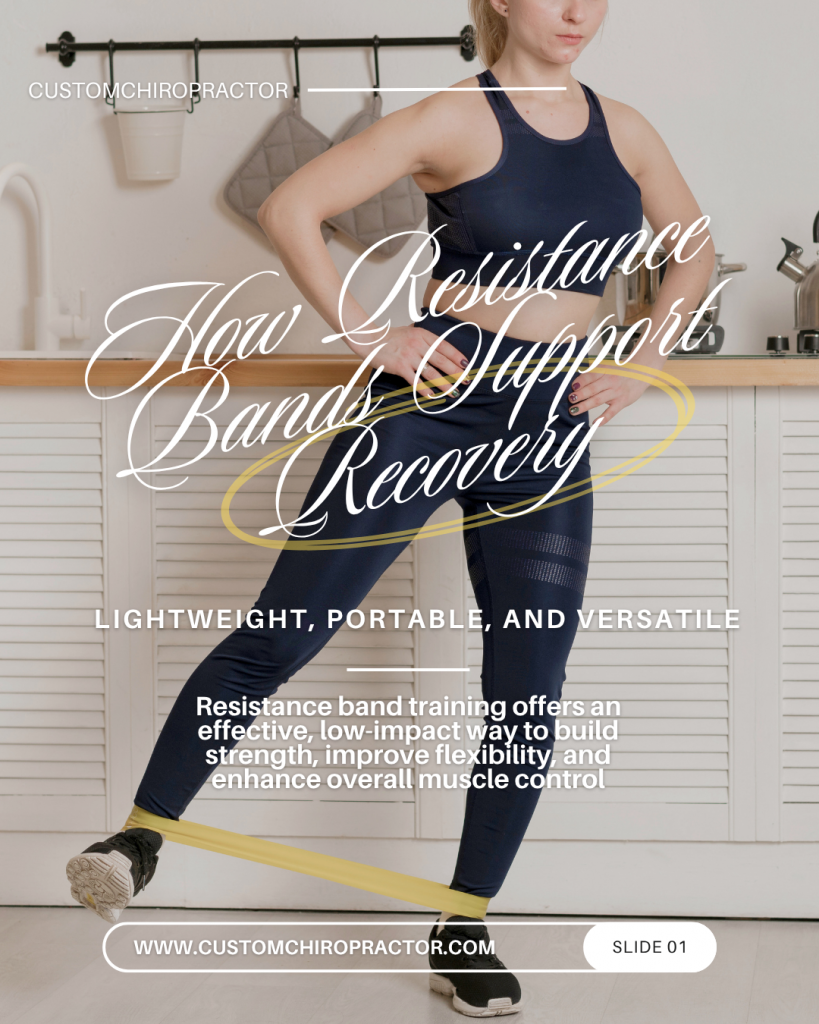
Tension That Helps: How Resistance Bands Support Recovery in Chiropractic Care
In modern chiropractic wellness, movement-based rehabilitation is just as important as adjustments. One of the most effective tools gaining attention is the Resistance Band. These simple yet powerful tools are transforming how patients rebuild strength, restore mobility, and maintain long-term spinal health.
Throughout this article, we will explore how Resistance Bands Support Recovery in Chiropractic Care is becoming a cornerstone of rehab programs, and how it enhances chiropractic outcomes safely and sustainably.
Understanding the Role of Resistance Bands in Chiropractic Care
To begin with, resistance bands provide a controlled and adaptable form of strength training. Unlike heavy weights, they allow patients to move through natural ranges of motion while minimizing joint stress. This is why the tension from Resistance Bands are frequently recommended in rehab programs.
At Custom Chiropractor, movement-based recovery is emphasized because it supports long-term healing rather than short-term relief. Consequently, resistance bands are becoming a key component in modern chiropractic rehabilitation strategies.
Moreover, Resistance Bands Support is especially effective for patients who need gradual progression after injury or chronic pain management.
Why Resistance Bands Are a Game-Changer for Chiropractic Recovery
One of the primary reasons why Resistance Bands Support Recovery in Chiropractic Care is so effective is because it aligns perfectly with rehabilitation principles.
First, resistance bands support joint stability. By activating stabilizing muscles, patients improve balance and control around vulnerable joints such as the spine, shoulders, and hips.
Second, they promote controlled movement. Unlike free weights, resistance bands create variable resistance, meaning tension increases gradually as the band stretches. This helps patients stay within safe motion patterns.
Third, they offer low-impact strengthening. This allows the tension from Resistance Bands support recovery in chiropractic care ideal for individuals recovering from injuries, surgeries, or chronic musculoskeletal conditions.
For more clinical insights on rehabilitation exercise, you can explore resources from Mayo Clinic and Harvard Health Publishing.
How Resistance Band Training Supports Spinal Health
Another important aspect of how Resistance Bands support recovery is its direct impact on spinal health.
Firstly, resistance band exercises help improve posture by strengthening the muscles that support spinal alignment. Weak postural muscles often lead to slouching, discomfort, and long-term spinal stress.
Secondly, they enhance alignment by encouraging balanced muscle activation. As a result, the spine experiences less uneven pull and strain.
Thirdly, resistance band training reduces spinal load during exercise. Instead of compressing the spine like heavy lifting, bands create resistance without excessive pressure.
To learn more about chiropractic spinal care, visit Custom Chiropractor Services.
Improving Posture and Alignment Through Resistance Bands
In addition to strengthening muscles, Resistance Bands play a key role in correcting postural imbalances.
For example, many patients suffer from forward head posture due to prolonged screen time. Resistance band exercises help activate the upper back and neck stabilizers, restoring a more natural alignment.
Furthermore, consistent use of Resistance Bands supports long-term spinal conditioning, reducing the likelihood of recurring pain.
Controlled Rehabilitation for Safer Recovery
One of the most valuable benefits of Resistance Bands is the ability to control resistance levels easily.
Because patients can adjust intensity simply by changing band tension or position, it allows for highly personalized rehabilitation. This makes it ideal for progressive recovery programs designed by chiropractors.
Additionally, controlled resistance reduces the risk of re-injury, which is essential during early recovery stages.
Why Chiropractors Recommend Resistance Bands
Chiropractors increasingly recommend Resistance Bands because it encourages active participation in healing.
Instead of relying solely on passive treatment, patients engage their own muscles, improving circulation, strength, and mobility.
As a result, recovery becomes faster and more sustainable. At Custom Chiropractor Blog, many patient education resources emphasize movement-based recovery strategies like resistance training.
Simple Exercises to Get Started
To experience the benefits of Resistance Bands, patients often begin with simple exercises such as:
- Seated band rows for upper back strength
- Glute bridges with resistance bands for pelvic stability
- Standing shoulder presses for postural support
- Lateral band walks for hip alignment
Each of these movements reinforces the principles behind how Resistance Bands support recovery , making rehabilitation both effective and accessible.
Long-Term Benefits for Chiropractic Patients
Over time, consistent use of Resistance Bands leads to significant improvements in overall function.
Patients often report reduced pain, improved flexibility, and better posture. Additionally, they experience greater body awareness, which helps prevent future injuries.
Ultimately, Resistance Bands are not just a recovery tool—it becomes a long-term wellness strategy.
Final Thoughts
In conclusion, Resistance Bands represents a powerful shift in modern rehabilitation. By combining joint stability, controlled movement, and low-impact strengthening, resistance bands support both immediate recovery and long-term spinal health.
Whether used in clinic-guided therapy or home exercise programs, Resistance Bands continue to prove its value in chiropractic wellness.
To explore more about chiropractic care and rehabilitation programs, visit Custom Chiropractor.